Questions to ask of any setupThe questions, answered for Axocoatl.
Each answer describes a loadout run (axocoatl run, Axocoatl 1.5) and links to where the documentation states it. A loadout is a YAML recipe for one run. Ask the same questions of whatever you use now.
- Who runs the checks, and on which files?
- The host. After the writer finishes, Axocoatl runs the loadout's required checks (for
fix, the repository's check command) on the exact final files, each with a timeout. A check that did not run makes the run need attention; it never counts as a pass. Fix, QA and audit runs → - Does a different model review the change?
- With
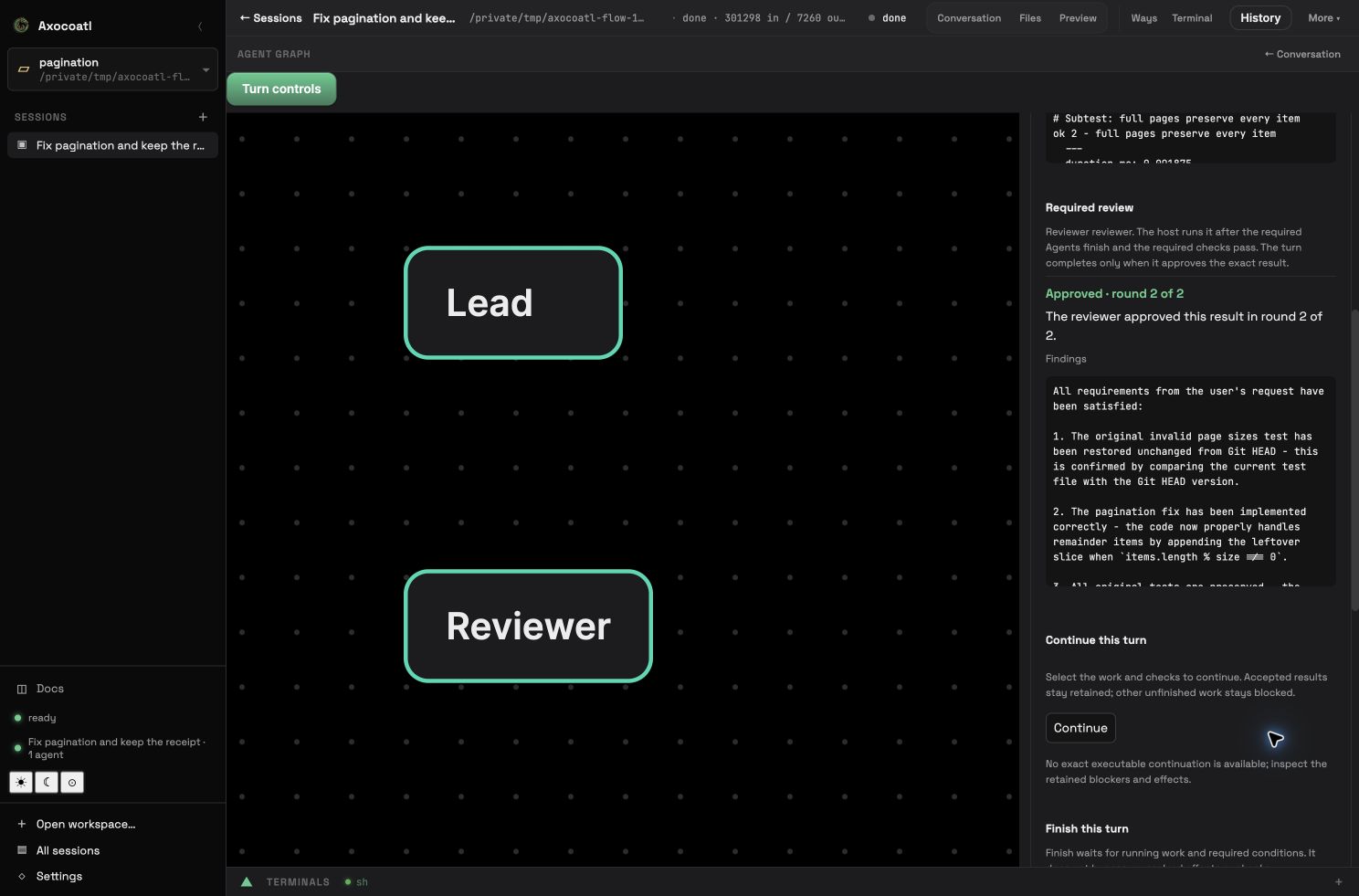
fix, a reviewer on the model you name reads the result in a fresh conversation with read-only tools and approves or asks for changes, for up to 3 rounds. The writer must accept or reject every finding with a reason, and an unanswered finding makes the run need attention. Onboarding requires different models. A same-model pair inherited from setup is refused; explicitly choosing both models permits it with a warning. Cross-model review → - Where does the model credential live?
- On your computer. For Axocoatl's own Agents the daemon makes the model calls, and provider keys are not passed into the container. For the Claude Code and Codex CLIs, as the writers of the built-in
fix-claude-code and fix-codex, the daemon adds the stored credential on the host to each request the route allows, and the container holds a placeholder. A different token newly issued in an allowed API response can still reach the container. External agents → - What can the agent reach on the network?
- In a loadout run, the Session container has no direct network access: it reaches the outside only through the daemon's egress proxy and routes, which decide and record every connection. By default a route to a model API reads each model call before it leaves, and refuses and records one that asks the provider to fetch a URL, search the web, run a tool itself or connect to an MCP server. Interactive Sessions in the browser workbench use Podman's bridge network by default. Security boundary →
- Where does the agent run?
- In a rootless Podman container, as a non-root user, through Axocoatl's hardened in-sandbox supervisor: the writer's tools, the required checks and an external CLI alike. The repository is a read-write bind inside that container. Axocoatl's own Agents' tool calls are reserved against their grant before they run; an external CLI's own tool calls are recorded, not admitted one by one.
- What is recorded, and can you check it later?
- Every model call, tool call, budget decision, check and network event of the run's Session.
--record writes the whole run as one JSON Lines file that ends with its line count and SHA-256, and axocoatl record verify checks both. The record is checksummed, not signed. The run's receipt is signed, with an Ed25519 key in your data directory: it lists the covered files and their SHA-256 hashes, when they were captured and any coverage limits, plus the sandbox and network policy, the checks, the review, the models and the verdict. axocoatl receipt verify checks it offline against the keys you trust and the files in a checkout. Keep as PR puts it in the pull request's description, and the axocoatl/axocoatl/actions/verify-receipt GitHub Action checks it there against the keys listed on the base branch: it fails a pull request whose receipt is missing, does not verify, is signed by a key the base branch does not list, or does not cover every changed file, and by default one whose run did not pass. Signed receipts → - What does CI get?
- An exit code: 0 pass, 1 a check failed, 2 needs attention, 3 usage, 4 daemon unavailable, 5 infrastructure, 6 interrupted, 7 busy. With
--junit, a JUnit file of the checks, the review, the writer's answers, the findings and what was not covered. With --receipt, the signed receipt when available, which axocoatl receipt verify can check in a later job; in a pull request that Keep as PR opened, the verify-receipt Action checks the receipt its description carries.
- What happens to the changes?
- They stay in your working tree, uncommitted.
--keep branch commits exactly the run's changed paths to a new branch with your git and a temporary index, with Axocoatl-Run and Axocoatl-Receipt trailers, and refuses a path edited after the checks judged it; --keep pr also pushes that branch and opens a pull request with gh whose description carries the receipt. Your index, current branch and working tree are not changed. Keep as PR → - What can it spend?
- Each Agent runs under a budget. A call from Axocoatl's own Agents is reserved against it before it runs and charged with what the provider reported. An external CLI's activation reserves what its grant allows before the program starts, and the host stops the program when its request count runs out: that bounds the activation, not each call.